AI text detector
Can Teachers Detect ChatGPT Essays? What Works, What Doesn't
· 1 min read
Teachers are in a hard spot. Students can generate a decent essay in under a minute, and detectors promise help, but they can be wrong. So what actually works? In short: use a detector as a conversation starter, and lean on things that are much harder to fake, like the student's own voice, drafts and ability to explain their ideas.
Key takeaways
- A detector result is a reason to talk, not to punish.
- False flags happen, especially on short or formal writing.
- Compare with the student's earlier work and ask them to explain.
- Process evidence like drafts is stronger than any percentage.
On this page
What a detector can tell you
It can estimate how likely a piece of writing is to be AI-generated and give you an AI percentage and a human percentage. That's useful for deciding which essays deserve a closer look, nothing more.
Why false flags happen
Short, formal or heavily edited writing looks statistically like AI text. Students writing in a second language and students who follow a strict template are flagged more often. That's why a percentage alone should never decide a grade.
Be careful: Please don't accuse a student based on a single score. It can be wrong, and the cost to the student is real.
Stronger evidence than a percentage
Some things are much harder to fake than a paragraph:
- Earlier writing from the same student, in class or at home
- Drafts and revision history in Google Docs or Word
- A short conversation: ask them to explain a paragraph or why they chose a source
- A brief in-class writing sample on the same topic

Try FakeSpot now
Paste text or upload an image and see the AI and human percentage in seconds. No files or results are stored.
A fair process
Start with the detector if you like, but treat a high score as a prompt for a calm conversation. Ask the student how they wrote it. Look at their drafts. Decide based on several things together, and tell students in advance how you handle suspected AI use.
| Step | What to do |
|---|---|
| 1. Notice | Something feels off, or a detector shows a high AI percentage. |
| 2. Compare | Look at the student's earlier work. |
| 3. Talk | Ask them to explain their ideas and process. |
| 4. Decide | Use all the evidence, not one number. |
Using FakeSpot for text
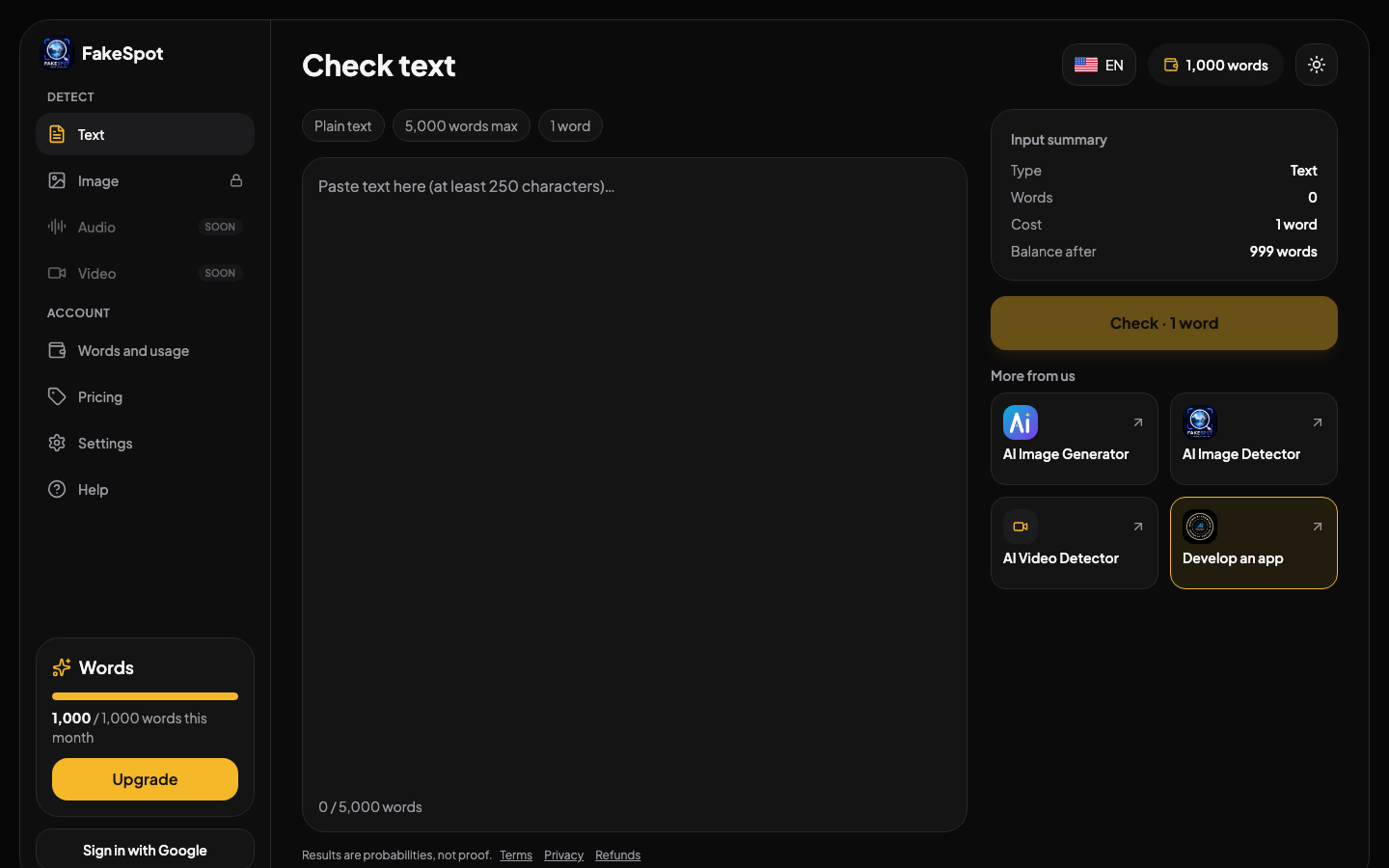
Paste the essay into FakeSpot (at least 250 characters, up to 5,000 words per check). You'll see the AI and human percentages and a verdict. The Free plan includes 1,000 words a month, and we don't store your text or results.
Frequently asked questions
Can a teacher prove a student used ChatGPT?
A detector can't prove it. Combine it with drafts, earlier work and a conversation with the student.
Why was a student's honest essay flagged?
Short, formal or polished writing can look statistically similar to AI text. Every detector has this limit.
Is it okay to run student work through a detector?
Check your school's policy first. FakeSpot doesn't store text or results, but your school may have its own rules.
Try FakeSpot now
Paste text or upload an image and see the AI and human percentage in seconds. No files or results are stored.
Results are probabilities, not proof.